@ayeshargoyal
Role-play ("if I were a snack company, here are three legal tricks to manipulate you") that teaches Indian label literacy: (1) split sugar into many names so it drops down the ingredient list, (2) set a small serving size so the per-serving numbers look low, (3) reformulate slightly and print "30% less sugar" on the front; counter-moves are to read total/added sugar, the per-100 g column, and the asterisk comparison. Category fit note: it is food education, filed under reel scripting/hook craft because the inverted "if I were the villain" format is the lesson for us.
563k plays · 10 Sep 2026
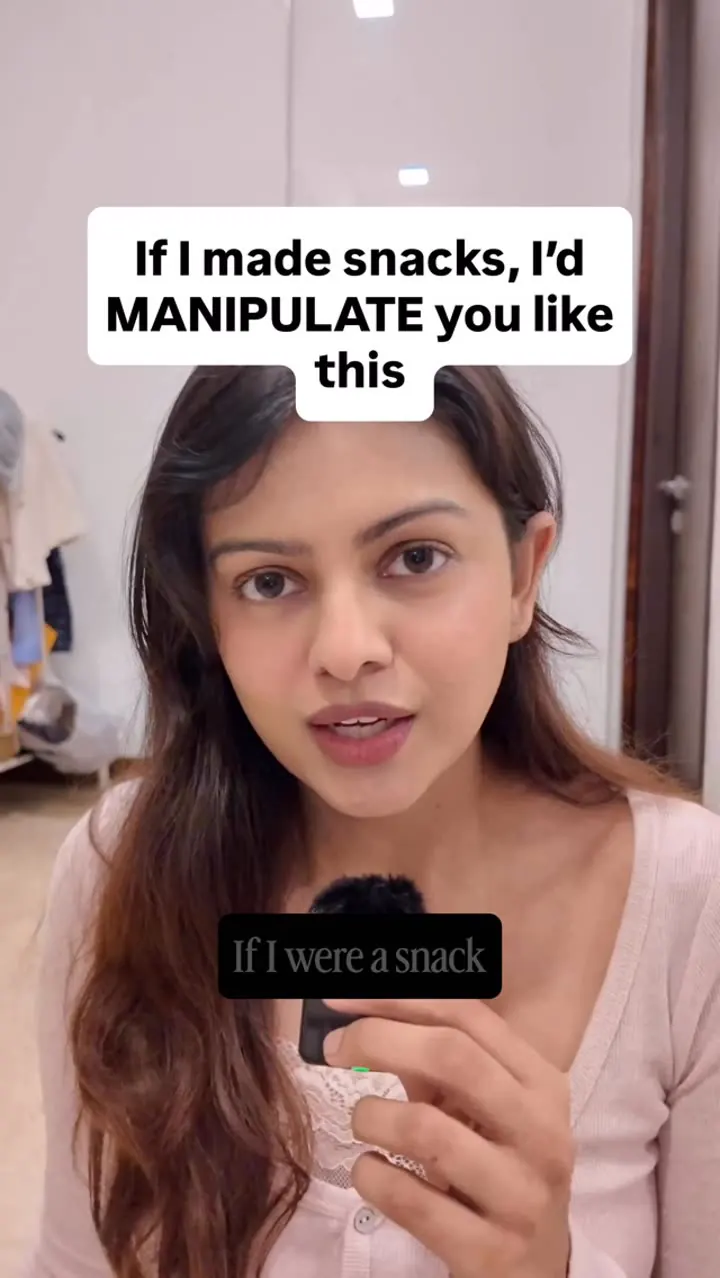
What they said
Trick 1: play with the sugar
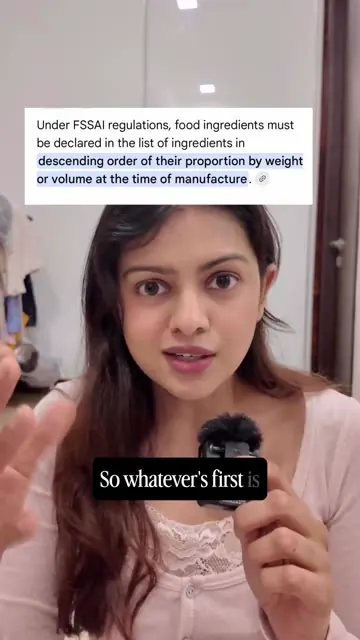
- FSSAI rule: ingredients must be listed in decreasing order (by weight at time of manufacture; a screenshot reads "Under FSSAI regulations, food ingredients must be declared in the list of ingredients in descending order of their proportion by weight or volume at the time of manufacture"). So the first ingredient is what the product has most of.
- Mock cookie list shown: "Sugar, Whole Wheat Flour (Atta), Palm Oil, Cocoa Powder, Milk Solids, Leavening Agents, Emulsifiers, Salt, Artificial Flavours": sugar first = "awkward".
- Fix: "sugar has 50 names that I can use": choose names consumers think are healthy: jaggery, brown sugar, honey, fruit concentrate (a circular graphic shows sugar, jaggery, honey, glucose syrup, invert syrup, fruit concentrate, fructose, brown sugar). Each is listed separately, so the new list reads: "Whole Wheat Flour (Atta), Edible Vegetable Oil, Fruit Concentrate, Honey, Cocoa Powder, Milk Solids, ..." and sugar disappears from the top.
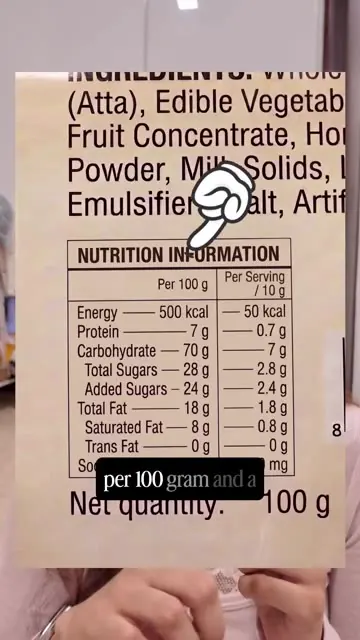
- How to beat it: look at "total sugars" and "added sugars" lines in the nutrition table (circled: total sugars 28 g, added sugars 24 g per 100 g). Trick 2: play with the serving size
- Every label has a per-100 g column and a per-serving column; the company decides the serving size, which is not the size of the whole packet. In the example one serving = one cookie (10 g), so 50 kcal per serving ("not too bad").
- Mock nutrition table per 100 g: energy 500 kcal, protein 7 g, carbohydrate 70 g, total sugars 28 g, added sugars 24 g, total fat 18 g, saturated fat 8 g, trans fat 0, sodium 300 mg; per serving: 50 kcal, 0.7 g, 7 g, 2.8 g, 2.4 g, 1.8 g, 0.8 g, 0, 30 mg. Net quantity 100 g.
- How to beat it: always look at the per-100 g column. Analogy: alcohol strength is the same whether you drink one glass or many; per-100 g tells you how concentrated the food is. If added sugar is 24 g per 100 g, "that means 25% of every cookie you pick up is sugar". Trick 3: reformulate the product
- Original 40 g sugar per 100 g; new version 28 g per 100 g; the front of pack says "30% less sugar" (pack mockup: "Chocolate chip cookies, 30% LESS SUGAR"). The consumer assumes it is healthy, but it is only better than the previous version.
- How to beat it: look for the little asterisk to see what it is compared against.
- Sign-off: hopes she didn't "rage" at viewers too much; wanted to show clever tricks that can be used to sell snacks. Caption (extra points she could not fit in the reel):
- Jaggery is the biggest myth: different from white sugar in colour/taste, not chemistry; both are mostly sucrose; the mineral content is not enough to matter. So when the front says jaggery, honey or dates, "that's sugar".
- Sugar free, low sugar and no added sugar are three legal claims: sugar free up to 0.5 g per 100 g; low sugar up to 5 g; no added sugar only means none was added on top, so a juice can carry 10 g per 100 ml from fruit.
- Multigrain only means more than one grain; a ragi biscuit can be 5% ragi and the rest maida; if ragi comes after maida in the list, it is a maida biscuit with ragi sprinkled.
- Sugar free biscuits: sugar goes, maida and fat stay, sugar alcohols like maltitol come in (still calories); turn it over and read the calories.
- Baked not fried: less fat maybe, but same salt and refined starch; check sodium per 100 g.
- The small %RDA column on the back is calculated on the company-chosen serving, not the packet: how 4% becomes 20% once the pack is empty.
- Hashtags: #indiahealth #health #nutrition #psychology #foodscience. In comments she adds: genuinely healthy snack benchmark = low-sugar, about 5 g sugar per 100 g.
Try this
- Food and supplement brands: Read your own label the way a sceptic would. Show per 100 g and per serving, name added sugar, and avoid serving sizes that flatter the numbers. Honest labelling can differentiate you.
- Shoppers and educators: Teach three label checks: sugar split across many names, small serving sizes, and "30% less sugar" claims. Compare against the asterisk, per-100 g column and total and added sugar lines.
- Creators: Reuse the "if I were the villain, here are three legal tricks" hook. Explain each trick, then give a "how to beat it" tip, which makes a clean three-part structure.
- Other industries: Adapt it, for example for jewellery (plating versus solid gold, karat labels, total carat weight) or any category with confusing claims.
- Agencies: Audit packaging copy. A claim like "30% less sugar" should state what it is compared against.
- Note: Check numeric thresholds against your local food regulator before repeating them, because the reel's figures are not verified.
Links
- FSSAI (Food Safety and Standards Authority of India) ingredient-listing rule (screenshot shown).
- Mock label graphics she built (ingredient lists, nutrition table, sugar-names wheel, mock pack). No app or link. A commenter compares her to @foodpharmer (a well-known food-label creator).
Watch the original
Watch the full reel on Instagram by @ayeshargoyal. Follow them for more.
Video, voice and ideas belong to @ayeshargoyal. Shown here as a short preview with our own summary, for commentary and education. Want it removed? Tell us.
00:00
/
00:00

More Scripting


Liked this one? Get the next
When I find a reel worth acting on, you get the short version: what it says and what to do. Free, rare, one click to leave.
Rather have it done for you? Work with Tanish